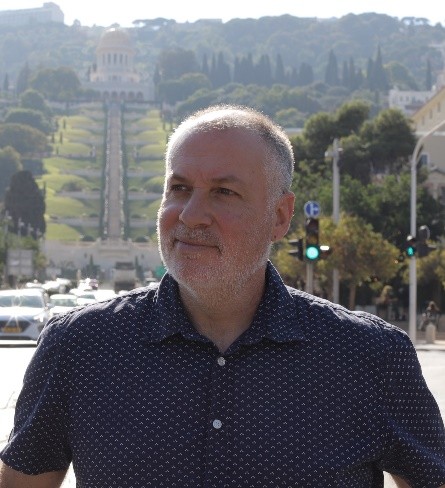

Prof. Uriel Simonshon
Head of the Haifa Laboratory for Religious Studies
Uriel Simonsohn is a Professor in the Department of Middle Eastern and Islamic Studies at the University of Haifa and the founding director of the Haifa Laboratory for Religious Studies (HLRS). He earned his B.A. and M.A. in Islamic and Jewish history from Tel Aviv University and completed his Ph.D. in Near Eastern Studies at Princeton University in 2008.
Over the years, he has held prestigious fellowships at institutions such as the University of Konstanz (2016), the Hadassah-Brandeis Institute (2017), the University of Oxford (2019), the Israel Institute for Advanced Studies (2020–2021), and the University of Münster (2024).
As the founding director of the HLRS, Simonsohn spearheads efforts to bridge academic research with practical applications, focusing on promoting religious pluralism and fostering interfaith dialogue. His work aims to integrate religious studies with actionable strategies that encourage peaceful coexistence and mutual understanding.
Latest Publications
This article examines the Islamic adaptation of the Maccabean story of the mother and her seven sons as preserved in the ninth-century Baghdadi ascetic Ibn Abī l-Dunyā’s al-Ṣabr wa-l-thawāb ʿalayhi. While the story is well known in Jewish and Christian martyrological traditions, its Islamic version has received little scholarly attention. Through close textual comparison and... When we speak of ‘Islamic societies’ or ‘Islamic civilisation’, we often imply that there is something distinctive about cultures wherever Islam is prominent. Yet historians have rarely examined in detail how these cultures that we call ‘Islamic’were formed in relation to neighbouring ones. This volume addresses that gap by focusing on cultural brokerage: the process... The Hamas attack of 7 October 2023 and the ensuing war profoundly destabilized Jewish–Arab relations within Israel, intensifying fear, mistrust, and intercommunal tensions. Focusing on the mixed city of Haifa, this article examines the potential and limitations of interreligious dialogue under conditions of acute conflict. It analyzes the Haifa Multi-Religious Initiative, convened by the University... By focusing on Jewish converts in early ʿAbbāsid Iraq, this article examines individual cases to propose a methodology for assessing the cultural agency of converts. It argues that the liminal qualities of converts – marked by marginality and ambiguity – offer key insights into their cultural impact. Through an exploration of both historical figures and... When considering questions of integration, assimilation, and adjustment in the formative centuries of Islam it is vital to think about the individuals who converted to Islam. The gradual nature of conversion and the enduring ties of Muslim converts to their former coreligionists kept them in a liminal position. My analysis will evolve around three spheres... It is commonly accepted that narratives and legal prescriptions of the first few centuries following the rise of Islam that featured gender relations were couched in patriarchal ideals. Accordingly, men were supposed to monitor some of the most mundane aspects of women's behavior in public, and the domicile was seen as a woman's immediate and...
Islamic Ascetic and Christian Monastic Ties in Early Abbasid Iraq: Ibn Abī l-Dunyā’s Adaptation of the Maccabean Story of the Mother and Her Seven Sons
Cultural Brokerage in Premodern Islamic Societies
Interreligious Dialogue in Haifa: Challenges and Prospects of Religious Leadership Engagement in the Shadow of War
Cross-Religious Cultural Agency: The Liminal Features of Jewish Converts to Islam in Early ʿAbbāsid Iraq
Exploring the Liminal Characteristics of Muslim Converts: An Analysis of Rabbinic and Ecclesiastical Legal References from the Early Islamic to Abbasid Periods.
The Subversion of Gender Hierarchies in Şahābī Dialogues
In the Media